Static routing supports priority adjustment
Function overview:
Administrative distance (AD)
- Used to determine the credibility and priority of routes learned by different routing protocols. The lower the AD value, the more trustworthy the protocol is, and routes with lower AD are preferred.
Static route priority (metric)
- The priority of static routes is defined by a metric. The metric is a criterion used to evaluate the quality of a path, and is usually used to determine the optimal path from multiple paths.
Configuration instructions
"Tenant"→"Config"→"Site"→"Edit Site"→"VRF Static Route"
"Tenant" → "Config" → "Network Service" → "Nova Gateway" → "Static Routing"
- Static route management distance and priority configuration page
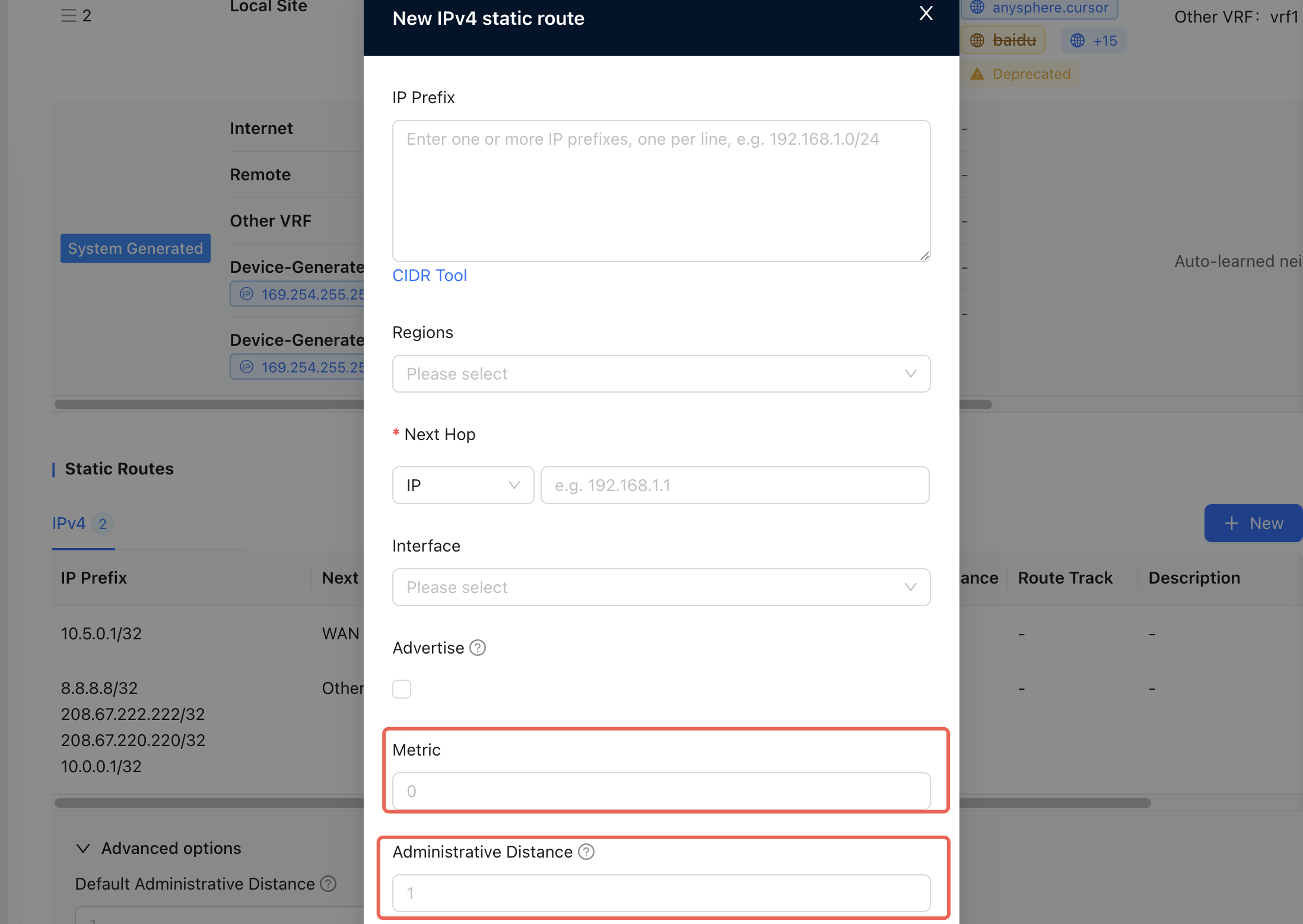
Static routing global management distance configuration page
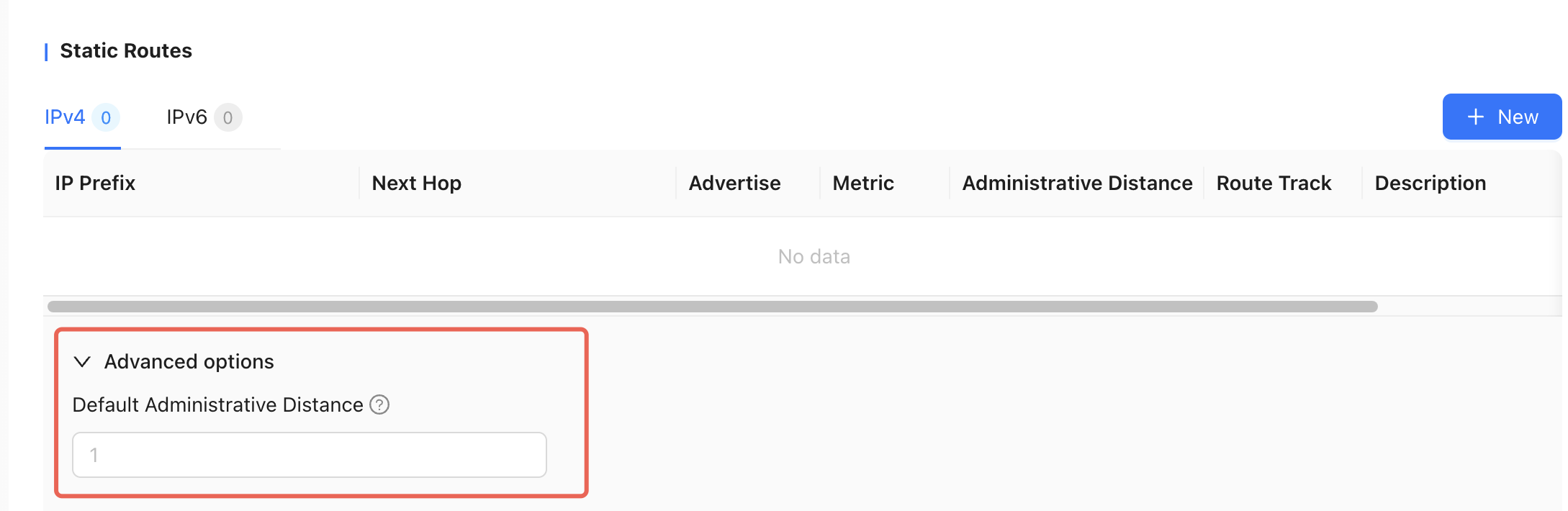
- Configure the global administrative distance of the static route and the administrative distance within the static route at the same time. The administrative distance within the static route has a higher priority than the global administrative distance.
Examples of usage scenarios
Administrative distance (AD)
In complex networks, such as when dynamic routing protocols are used, routing loops may cause network performance degradation or network paralysis. When the network topology changes, or a path fails, packets may loop endlessly in the network without an appropriate mechanism to handle the traffic. You can configure static blackhole routing with lower priority to ensure that when a problem occurs with the dynamic routing protocol, the traffic will not be looped but will be dropped to maintain network stability.
Static route priority (metric)
To ensure redundancy and high availability, backup paths can be configured. The primary path uses a lower metric value, while the backup path uses a higher metric value. When the next hop track on the main path is unavailable, traffic can be switched to the backup path for forwarding.